Bishop of Bath & Wells
I have been ploughing through my unpainted minis lately and, at the bottom of a cupboard, discovered an entire unpainted Blackstone Fortress game. And they are great models.
First up the good Bish' of Bath and Wells with his lovely assistant - all ready to toast those babies.
I have completely mislaid my Tamiya textured paint so finishing the base will have to wait for another day.
By, By Bishop, Goodbye....
Thursday, 27 February 2020
Monday, 24 February 2020
Hellenistic Ersatz Legionaries
Hellenistic 'Legionary' Infantry
At a parade in 166BC, Polybius refers to a 5,000 man unit of Seleucid infantry as armed 'like Romans'.
The question is how really like a Roman legion was this Hellenistic unit.
The key military attacking unit in World War II was the Armoured/Mechanised Division. No purely infantry army could win against a foe fielding these units. After WWII, armoured and mechanised divisions remained as the primary military units facing each other in The Cold War. Newly emergent nations with the cash to spare were keen to create their own modern battle winning divisions. They copied NATO or Soviet divisions, buying the vehicles and creating the ranks and uniforms. But these ersatz armoured divisions, good as they looked on paper, were found wanting in a real war. You can't make a Russian armoured division simply by buying the gear. You need Russian to man the tanks.
So what were Seleucid 'legionaries'? Hellenistic armies already had Thureophoroi and Thorakitai, infantry with helmets, large Gallic shields, spears & javelins, swords and, sometimes, mail armour? Even if Hellenistic kings equipped their troops with Italian rather than Gallic shields and heavy javelins rather than spears and light javelins, that wouldn't make them legions.
The point of the legion wasn't just the gear, but the training and battle tactics to use same - such as the flexible maniples, the line rotation in battle, the four types of troops, cohorts and so on.
Hellenistic Infantry
Whatever, Hellenistic legions have become a staple of wargames so I have some for my new 15 mm army.
Mine are sourced from Xyston, and I got them from Rochester Models.
Wednesday, 12 February 2020
Review Warcry: Unmade
Unmade Warband - click to enlarge.
Warcry is, in my view, a much underrated fantasy skirmish wargame from The Evil Empire. It uses doubles and trebles, etc, from the roll of a set of dice to allow pieces to undertake actions of various complexity. The background is of small chaos warbands, not drawn from the usual factions, roaming the Eight Points realm trying to carry out great deeds to impress The Everchosen of Chaos. Mostly this involves beating up other small warbands.
The Unmade are one of those bands from the Realm of Shish (Realm of the Dead). They worship chaos in the form of pain and to be in an Unmade warband you have to cut your own face off and wear it as a belt buckle decoration - yes, even by GeeDubya standards this is really gruesome. Such a warrior is known as Awakened.
Yep, you really have to suffer for your wokeness in Age of Sigmar.
Moving up in status, a warrior is allowed to cut an arm off so as to permanently attach a weapon. These are the Ascended.
The second in command get to cut both arms off - an honour indeed - which is presumably why they are know as Joyous Ones.
But the leaders are the pièce de résistance. They are known as blissful ones because they get to cut off their legs as well as their arms - and become bladerunners.
The models are some of the best Citadel have made. Really, really beautiful .....in a sadomasochistic sort of way. My only criticism, and it applies to all the Warcry warbands, is that they are a bit delicate as playing pieces. Gorgeous models for a diorama set in an insane world, though.
Highly Recommended (the game ain't bad, either)
Tuesday, 7 January 2020
Thureophoroi - Club Paint Challenge
My local wargame club has a painting challenge. I have set my target at painting two units a month for a new MeG 15mm Hellenistic ancients army.
These are Xyston miniatures from Rochester Models.
I haven't bought a 15 mm army for decades and was stunned by the quality of the current models.
Thureophoroi are a type of infantry that were used across the Hellenistic world. They were named after the oval 'Celtic-style' shield presumably adopted after the Galation intrusion into the Greek world; the Thyreos is the shield.
Thureophoroi or thyreophoroi were a kind of jack-of-all-trades infantry type that could operate in all types of terrain. Apart from the shield, they had only a helmet for protection and were armed with javelins and/or a long single-handed thrusting spear thought to be Thracian in origin. Thureophoroi were used to support light infantry and could operate either in loose or order.
They were commonly used by small city states as cheap paramilitary forces. Many Greek mercenary troops in Macedonian or Hellenistic armies were probably Thureophoroi. They would be used to guard the camp or as flank defence for the heavy infantry. Plutarch reports them as ineffective when used as line-of-battle troops against real heavy infantry such as phalangites.
Any Hellenistic army from Alexander onwards should include Thureophoroi.
Eventually some seem to have been up-armoured with mail shirts to produce Thorakitae that were presumably better drilled for close-order combat. Thorakitae may be the 'ersatz Roman' troops reported in late Hellenistic armies although their equipment is pure Galatian/Thracian
Monday, 4 November 2019
Dogfight Doubles: Fokker Fodder
The Fokker
This is a new retooled kit of a Fokker E.III: E as in Eindecker or One-Wing.
The Fokker E Models were essentially copies of a 1913 French Morane-Saulnier Type H. They were not particularly great aircraft but in Summer, 1915, an E.I fitted with an MG synchronised to fire through the prop turned the E.I into a lethal killing machine.
Monoplanes were not an optimum choice in 1915 compared to biplanes. Available aero engines were only about 100HP. Monoplanes needed long wings to get any lift with such low power units which increased the structural rigidity problems greatly adding to weight and lowering power to weight ratio even further. Biplanes wings gave more lift for less weight at slow speeds due to their inherent box-like rigidity. The biplane had a great deal more drag than a monoplane but, with the low powered engines, speed was never an issue.
The E.III could work itself up to about 87 mph.
The Fodder
This is an RAF (not that RAF) BE2C fighter and is another excellent retooled Airfix kit.
The BE2 first flew in 1912 and was designed for observation and reconnaissance operations at a time when planes were unarmed. It was a very well designed stable plane with the chauffeur at the back. In fact it was so stable that it was almost impossible to carry out anything resembling an evasive manoeuvre. Up against an E.III it was dead meat: it couldn't run, it couldn't dodge, and it couldn't fight.
They did fit a machine gun for the observer but he was in the front of the plane, in the middle of the wings and struts with the pilot's head directly to the rear.
This model is the night fighter version designed in 1915. The observer's place has been taken out and replaced by a fuel tank. A Lewis gun has been added, operated by the pilot and firing vertically upwards. The upward firing gun, filled with explosive and incendiary ammunition, and the stable flight characteristics made the BE2 a perfect nightfighter. In 1916, Leefe Robinson shot down Zeppelin SL11 in one of these in Sept., 1916. BE2 nightfighters went on to take down five more Zeppelins in three months halting Germany's strategic bombing raids on Britain - but by January it was obsolete.
Nevertheless, the 90HP, 72 MPH BE2C nightfighter had its brief moment of glory.
Wednesday, 25 September 2019
Review Aeronautica Imperialis: Wings of Vengeance - 2 The Models
Fly Boyz
Inside the starter set are models for two factions. Lets start with the Orks. Inside the box are two Fighta-Bombas and three single seater Dakka Jets.
The models are easy to assemble unlike some of GW's recent offering. Details are astonishingly crisp with wing panels well delineated. The Dakka Jets, in particular come in modular form giving a huge potential variety between planes. There are also a variety of rockets, bombs and shootas to hang under the wings.
The photo is high res so do click on it and blow it up for a better look. I have exaggerated the contrast slightly with Paint Shop Pro.
I undercoated in light tan and then used Citadels Bright Red contrast paint (the runny stuff that collects in the hollows) for the topcoat, and Citadel Contrast Yellow Ochre or VJ Metallic Brass for wing panels, decoration etc. The Contrast Paint didn't make the panels stand out enough so I dribbled black wash along the lines.
These are enough planes for a decent evenings two hour game. Additional boxes can be bought off GW in squadrons of six Dakka Jets and Four Fighta-Bombas. That would give 15 models and is as much as you might ever want. I probably won't bother unless I split the models with a friend.
An additional Ork Eavy Bomba is on the way which I will buy as it will round out Deff Skwadron nicely - remember them?
Imperial Navy
The Imperial Navy's are the second faction, the starter set including two heavy Thunderbolt Fightas and two Marauder heavy bombers. Again the detailing is superb. Again the photo blows up if you click on it.
I undercoated the fighters with a Humbrol light grey spray can and liked the finish so much I decided to use it as a top coat. The engines are in metallic dark steel liberally coated with black wash, which I also ran into the panel lines.
The bomber are coated in Citadel Contrast mid blue-grey, again with the panel lines marked out in black wash.
As these are elite Imperial Navy squadrons I thought they would have squadron flashes on the wings and tail.
Underneath
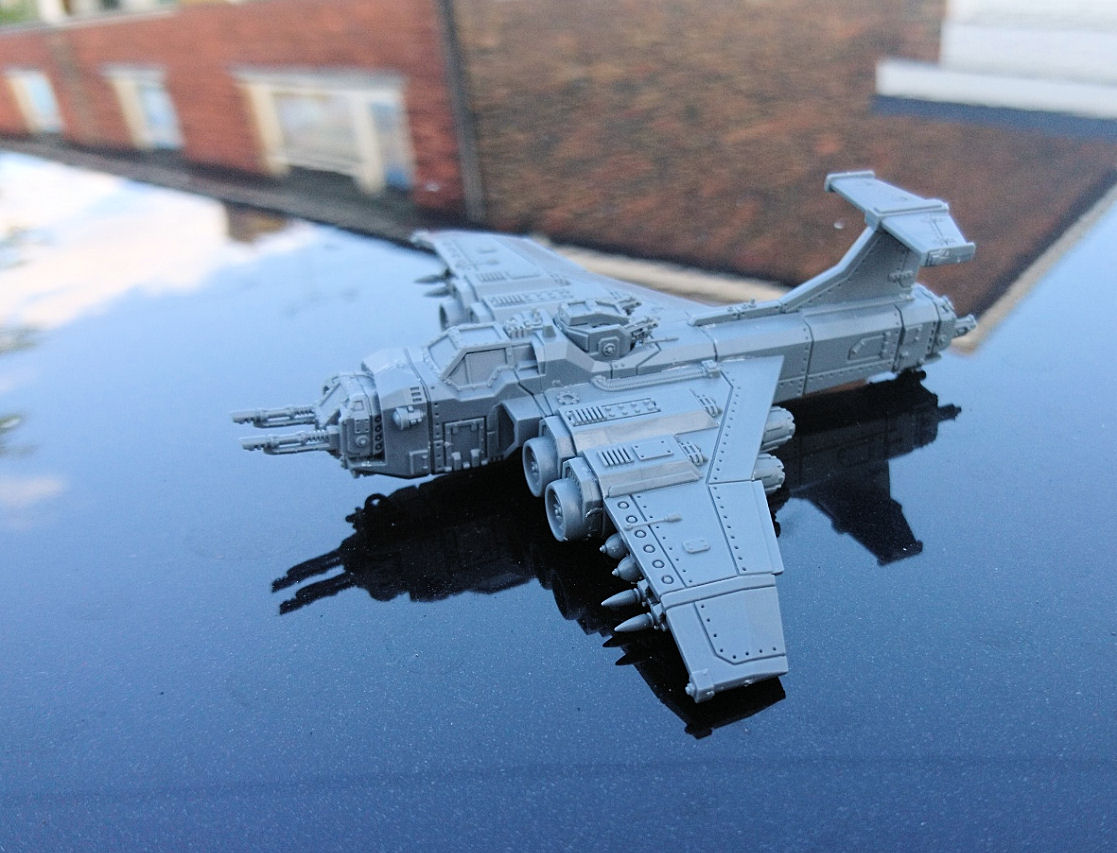
The high level of detail is continued on the undersides, even though you probably won't get to see them during play.
I am way too impatient to be a good painter - hey, I'm a wargamer not a modeller - so I did a quick minimalist job. Washes cover a multitude of sins. The models are so easy to paint that they look pretty good with very little effort.
Transfers are provided and I put a few on the Orky planes but I'm not a great fan. Somehow they never quite look right. The Ork planes in particular have very little in the way of flat surfaces.
Scales
GW commonly don't give scales on their models so I photographed a Marauder Destroyer against a 1/144 Lancaster and a 1/300 Canberra early jet bomber.
I would guestimate the AI models at somewhere around 1/200. They do apparently match the scale of the new Adeptis Titanicus game......stand by for a crossover.
The Marauder incidentally is the first of the add-on models released separately. Five factions are apparently waiting in the wings. Given the Rynn's World expansion book, I would guess that they are going to follow the campaign-in-a-box-with-models formula.....but I could be quite wrong about that.
I will probably buy one box of every release.
Highly recommended models.
-------------------------------------------------------------------------------------------------------------------------
Below are some photos of unpainted planes to give a better look at the raw plastic model.
Saturday, 21 September 2019
Review Aeronautica Imperialis: Wings of Vengeance - 1 Overview.

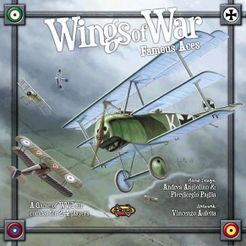
Wings of War
The story of Games Workshop's Aeronautica Imperialis game doesn't start with GW at all. It starts with an Italian game published in 2004 depicting World War I tactical air combat. Wings of War used an innovatory semi-board game mechanism where players chose hidden manoeuvres in advance which were revealed when a player moved a plane. The manoeuvres were depicted on the card and the player just moved his plane along whatever track was depicted, making such changes in facing as necessary. 'Extra' movement could be used in front and/or after the manoeuvre giving the player some flexibility.
Wings of War was taken up by Fantasy Flight and became a big success. They duly dropped it and it is now sold as Wings of Glory.

Aeronautica Imperialis
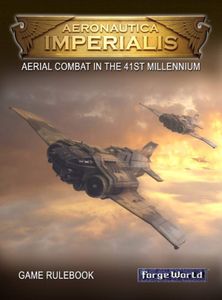
In 2007, Forge World published Aeronautica Imperialis, a 40K air game.
The mechanism of AI was a straight knock-off of Wings of Glory. You could move a bit, lay down a manoeuvre card and then possibly move again. The problem is that Wings of War was a pretty decent simulation of fragile wooden biplanes armed with light machine guns. An attempt to translate it into a WWII version was much less successful because WWII monoplane air warfare with cannon armed fighters was fought very differently. We will return to this point.

Aeronautica Imperialis: Wings of Vengeance
The first thing to notice is that the models in Wings of Vengeance are the wonderful plastic models. They are much bigger than the old Epic scale stuff from Forge World and are beautifully sculpted. I cannot speak too highly of them.
What is in the rest of the box though is not a game, but a taster for a game. The playing mat is too small, the rulebook is a cut down paperback version, and no playing cards are included - there are useful counters.
The game mechanism is virtually identical to Forge World's AI, and hence Wings of War except that the 'expensive to print' movement cards are gone and replaced by a sheet depicting available manoeuvres. To make this work, the game is played on a hex grid - hence the concern about the small size of the playing area in the box. As an aside, My friend, David S. claims that in some places in the cut and paste they have forgotten to turn cm into hexes.
Now this is a problem because what worked well as a simulation of fighting canvas biplanes with Lewis guns comes over as pretty damn odd when translated into supersonic jets. For example, although height is recorded in the game, ALL manoeuvres take place in the horizontal. After Polikarpov introduced the Rata in 1933 (until the rise of BVR missile combat, anyway) manoeuvring in the vertical has been way more important for tactical combat than the horizontal. The classic tactic from 1918 SE5a to MIGs in Vietnam is fast in, shoot, fast out: he who shoots and runs away, lives to get home for tea and medals.
And here is another strange example, or at least it seems strange to me. A plane in Wings of vengeance achieves its maximum safe speed in level flight. Diving to go faster risks structural damage. That seems more suited to canvas biplanes than jet planes. Also the weapons are strangely ineffectual. Modern missiles and cannon just smash planes out of the sky but Wings of Vengeance planes can survive multiple hits - well most of them, anyway.
Okay that's enough from me for now: more reviews on the models and a test game to follow.
So first impressions?
Great models, not sure about the game - but at around £50, it is worth buying just for the models. If you end up throwing the game away and just keep the planes, you still will have got value for money.
Subscribe to:
Posts (Atom)