Monday, 4 March 2019

Cruel Seas: Modelling Drache - The First Helicopter Carrier

Drache

It's the 26th September, 1943. You are looking through the gun-camera of a Bristol Beaufighter at a ship called the Drache - and she's taking a straffing from the Beau's four 20mm cannon and six .303 machine guns.

This time, she survived.

Drache is a very special ship because she was the very first to carry a helicopter on a flight deck.

Zmaj Sea Plane Tender

In 1928, The Royal Yugoslavian Navy decided it needed a  tender to support its seaplanes operating along the Dalmatian coast so commissioned an 83 M vessel from Hamburg that they named Zmaj - Dragon. The above drawing shows the ship as built with a central crane and two 3.29" Skoda AA guns plus two twin 40mm. The Zmaj carried a De Haviland Moth.

Minelayer

In 1937, the RYN converted Zmaj to a minelayer and used in that role during the German invasion. She was credited - and I use the word advisedly - with the sinking of of some Yugoslav civilian ships.

Zmaj was captured by the Germans on the 17th September, 1941 and renamed Drache - Dragon.

The Kriegsmarine re-designated her as a Flugzeugbergungsschiff (wonderfully expressive language - German), an aircraft rescue ship - pretty much changing the ship back to her original role

Schiff, Showing 4.1" Gun

At the end of 1942, Drache was moved to the Aegean and underwent a refit back to being a minelayer in the spring or summer of 1942. She was re-equipped with two 105 mm (4.1") guns, five 37 mm and six 20 mm cannon.

Stern 

Minedeck

A rear platform was added with space for 240 mines on four rails.

The Germans also renamed her Schiff, but she is better known as Drache so I use that name here. Drache was successful as a mine layer, laying fields sinking two allied destroyers and blowing the bows off a third.

Brandenburg Marine Commando Boarding

She took part in the Aegean campaign, serving mainly as a troop transport; a task for which she was well suited due to the large uncluttered rear upper deck.

Flettner Fl 282 Kolibri ("Hummingbird")

The same deck made Drache ideal for trials as an experimental helicopter carrier. The chopper was unarmed and intended to be used as a spotter - submarines being visible at some depth in the clear, impoverished Mediterranean.

Drache - Final Appearance

On the 22nd September, 1944, Drache was anchored in Vathy Harbour on the island of Samos when the Beaufighters finally got her. Despite her heavy AA, the planes set her alight, killing her captain and many of the crew. She exploded and sank two hours later.

Model

I made the Drache using the resin hull from a Warlord Games German minelayer as a base. This entailed changing the bridge, extending the raised fo'c'sle, flattening the rear, and laying a top deck. I should have moved the 'funnel' aft but it is an integral part of the resin hull and I confess that i just couldn't be bothered to chop it off and make a new one.

Landing Deck

The Flettner is a 1:300 metal model from Heroics & Ross. The chopper is manned and the deck crew are giving the go ahead to launch (more H&R German infantry models).

Successful Launch

The Flettner is up, up and away!

Action Stations

But what's this! After recovery of the aircraft a sneaky Beaufighter attacks at low level.

Kaboom

And straddles the Drache with a stick of bombs, setting the aircraft fuel alight.

Lucky Escape

A Spitfire makes a pass at a Warlord Games Stuka over Bomb Alley in 1940.

I have to say that these Warlord 1:300 planes are amazing. They are so detailed with recessed panels. Old 1:72 kits rarely managed recessed panels. Apparently, it's because of the modern use of CADCAM techniques.

The old unbranded Spitfire model from my collections is nice but it can't compare.


Monday, 11 February 2019

The Wine-Dark Cruel Seas: Making A Special Boat Section Schooner

Sailing The Wine-Dark Seas

In the coastal waters around the Balkans, the Adriatic and the Aegean, a wide variety of local small ex-coastal craft were used by both sides. These were converted civilian ships that island-hopped carrying people, animals and goods. One of the types was a number of different sized 'schooners', usually with cut down masts and an engine fitted.

I wanted to create just such a vessel as might have been used by the Special Boat Section of the Royal Marine Commandos.

Armed Coastal Schooner

I started with the small Airfix Cutty Sark kit, using the two hull sides and the deck. The hull is a bit narrow for a small schooner in 1:300 but I assume that this was a fast sailer, maybe serving as a private cruise yacht in an earlier life when it was new. On the plus side the cabin and hold entrances are just the right size with a 1:300 infantryman being able to peer over the top from the rear helm position.

I only retained half of one mast with a single sail. The original schooner as built would have had two. The SBS used Matilda Tank engines, rather than whatever the locals had added as a power unit.

I added four depth charges at the rear on side-rails, a 20mm autocannon on the quarterdeck and a 3 inch naval gun behind the fo'c'sle. The 20mm is an Heroic & Ross flak gun and the 3 inch is a 25pdr artillery piece with the wheels cut off mounted on its round platform. I placed a heavy mortar on the fo'c'sle.

I used different coloured uniforms: navy blue for the helmsmen and 20mm gunner, and khaki for the bow gunners. The aim was to make it look like a mixed crew of SBS and commandos.

Scale Photo

This pic shows the schooner against another coastal bodge, the German Siebel ferry, to give an idea of its size: small! But it does pack a surprising punch.

Adriatic Schooner Stats

Hull Points 20; Small, Turn 45
Speed; Slow 3, Combat 6, Fast 9
Bow Mortar
3" Front Gun
20mm Rear Gun
Deoth Charges
Cost: 45 pts (+5 if you use the mortar).


Tuesday, 29 January 2019

Cruel Seas: Kitbashing The Kriegsmarine TA 48 Torpedoboot

TA48

In a book by Zvonimir Freivogel on the coastal war in the Adriatic, I came across a fascinating story concerning the TA 48 Torpedoboot. There doesn't seem to be a photo of this ship but Freivogel includes this drawing.

78 T - Austro-Hungarian

78 T was one of the SM 250T single funnel sea-going (sort of)  torpedo boats, built at Trieste in 1914 for use in the Adriatic. As built she had two 66mm cannon and 2 double torpedo tubes, a dozen mines and could achieve 28 knots.


T3 - Yugoslavian

After WWI and the break up of the Austro-Hungarian Empire, the boat was allocated to the KSCS Navy, later the Royal Yugoslav Navy.

T3 - Italian

In 1941, T3 was captured in port during the Invasion of Yugoslavia and allocated to the Royal Italian Navy. They partially modernised her by replacing her cannon with two 3 inch AA guns.


TA48 - Kriegsmarine (Nominally Croatian Navy)

In 1943, after the surrender of Ital, the Kriegsmarine captured T3 in the port of Rijeka and renamed her TA48. They removed the front torpedo tubes and replaced the stern 3" with a 37mm flak gun. In addition they fitted two 20mm autocannon in the bow and stern and possibly one on each wing of the bridge (information is a bit vague).

Largely crewed by Croats, TA48 was destroyed in  Trieste, where she had been made three decades earlier, by Allied aircraft. The date was the 20 February 1945.

Her sister ship, T1, was luckier - being returned to Yugoslavian service in '43 to survive in the Yugoslavian Navy until 1959. The twin-funnel Yugoslavian torpedoboot T7 (Austro-Hungarian F Class 96 F) also entered service in the Kriegsmarine (nominally Croatian Navy).

"On 24 June 1944, [T7] and the German S-boats S 154 and S 157 of the 7th S-Boat Flotilla were sailing between Šibenik and Rijeka, protecting German sea supply routes along the Adriatic, when they were attacked by the Royal Navy Fairmile D motor torpedo boats MTB 659, MTB 662 and MTB 670 near the island of Kukuljari, south of Murter Island.[20] Considering T7 one of the few significant threats to British boats in the region, the British commander ordered MTB 670 to launch a torpedo attack. The two torpedoes missed, so the MTBs pursued and approached the ship from abaft the beam. T7 opened fire at 150 yards (140 m). The MTBs returned fire with their forward and port guns, and within 30 seconds they had disabled her weapons and set her ablaze. At a speed of about 12 knots (22 km/h; 14 mph), T7 suddenly veered starboard, narrowly avoiding a collision with MTB 662 (it is not known whether her steering was damaged or if her crew was attempting to perform a ram) before running aground on Murter Island." From Reynolds, Dog Boats at War.

Torpedoboot A86

I can't find any Austro-Hungarian 250T torpedoboot kits but Mirage make a 1:350 kit of the German torpedoboot A86.

A88

The A86 was built during WWI and was around 330t, equipped with two 88mm cannon and a single torpedo tube. She could do around 28 knots. The A class are of a similar size and configuration to the 250t Austro-Hungarian torpedoboots so I decided to convert one. The A Class had a single funnel so I elected to make TA 48, rather than my first choice of T7.

TA 48 Model

And here she is.

TA48 Model Stern

I replaced the rear gun with an H&R 40mm model in 1:300 and swapped the single torpedo tube for a triple tube I had left over from another kit.

TA48 Bow

I also added two 20mm guns made from 1:300 light anti-tank guns that I had in the bitz box and added some spare Warlord Kriegsmarine crew.

Scale Photo

1:350 Mirage kit alongside a 1:400 Mirage Town Class Destroyer.

Scale Photo

And alongside a Warlord Games 1:300 S-Boot.


The rough Cruel Seas stats are as follows:

Large, Speed 28 knots (28, 18, 9), Hull 95, Bow 3" Cannon, Stern 37mm, One 20mm on bow and stern, One MG on each bridge wing, Two torpedo tubes.

With Regular Crew, 210 pts.


Friday, 25 January 2019

Cruel Seas: Aegean Commando Raid

Raid Flotilla

I've finished my Aegean commando raiding flotilla. The plucky chaps are off to launch an attack on a German held island and blow up some guns dominating a strait.

The commando is company strong, one platoon in each of the LCI(S) and one in the corvette acting as an HQ and escort ship.

Three Type 1 and three Type 2 Vosper 73 footers accompany the troop ships to shoot up port installation, torpedo any merchant or flak barges around and generally act as an escort.

Flower Class Corvette

Not sure there were any Flower Class Corvettes in the Med but they were ubiquitous so there might have been. Anyway, there is now.

Corvette From The Stern

Showing the mine-sweeping gear and depth charge rails, launchers and reloads.

Corvette From The Bow

Showing the 4" Mk IX WWI naval gun for anti-shipping use and shore bombardment.

LCI(S)

Each of these carries a platoon of Marine Commandos and is armed with two 20 mm autocannon for air defence (plus whatever the crew have 'acquired').

Comparison With Dog Boat

LCI(S)s were apparently designed by Fairmile, who made the Fairmile D 'Dogboat'.

Vosper Type 2 MTB

Vosper Type 1 MTB


The Vospers are Warlord Games, the LCI(S)s Scotia Grendel and the corvette Mirage Hobbies. All are 1:300 except for the corvette which is 1:350.


Monday, 21 January 2019

'Allo, 'Allo

Nouvion Fishing Quay

Listen very carefully; I shall say this only once.

Somewhere in this picture are two British airmen waiting for Rene to smuggle them onto a fishing boat which will rendezvous with a British Vosper out in the Baie de Somme.

Ha, now you see them. They are disguised as lobster pots.


Sunday, 20 January 2019

Cruel Seas: Scratch Building The Siebel Ferry (Siebelfähre)

Scratch Built Siebel Ferry, Bow To The Left

This is a scratch-built Siebel Ferry flak lighter made by an expert modeller (not me) in large scale.

The ferry has four flak 88mm cannon and two 40mm autocannon. Boats like these escorted convoys and acted as flak batteries, for example during the German withdrawal from Sicily across the Straits of Messina.

WWII Photo

Here is a photo of a real one with four 88s and two quad 20mm flak guns. We are looking at the back.

Luftwaffe Sea Lion Ferry, Rear View

The story of the Siebel starts with Operation Sea Lion. The Kriegsmarine pointed out that they lacked the lift to move anything like the army's requirement for the first wave across the Channel. So the Luftwaffe asked Aircraft Designer Fritz Siebel if he could make rafts from oil drums to be powered by spare French aero engines. The German Army was to cross the Channel on Boy Scout rafts. Of course they fell apart microseconds after hitting the surf.

Siebel had the idea of taking two pontoon bridge floats and bolting a flat deck over them. Actually this worked quite well but the Wehrmacht showed a marked reluctance to a sea voyage lasting four or five hours of bracing themselves to avoid being sucked into a mincing machine. Aircraft engines and air propellers are also thirstier than a drunk waiting for opening time and there was some doubt whether the craft could carry enough fuel to get itself over England's anti-tank Ditch, never mind with a payload.

Fritz Herbert, an Austrian engineer, arrived at the final design which had propellers and diesel engines.

Each ferry would have carried a single 88 and two 20mm flak with their trolleys and prime movers. With this they were intended to guard the flank of the barge convoys and see off Royal Navy Cruisers and Destroyers..........[Facepalm]

According to Peter Schenk, 'the Army rather disingenuously referred to the Siebel ferries as “destroyer substitutes”'......yeeesss, that would be chocolate soldier.

Any that reached Kent were to unload and then act as ship to shore lighters.

Okay, Sea Lion was a dead duck that never tried to swim but the Siebel became one of the most useful coastal boats in the Kriegmarine's inventory. They were used as ferries, escorts, flak batteries and mine-layers. A Siebel could carry a Tiger Tank.

Basic Requirements

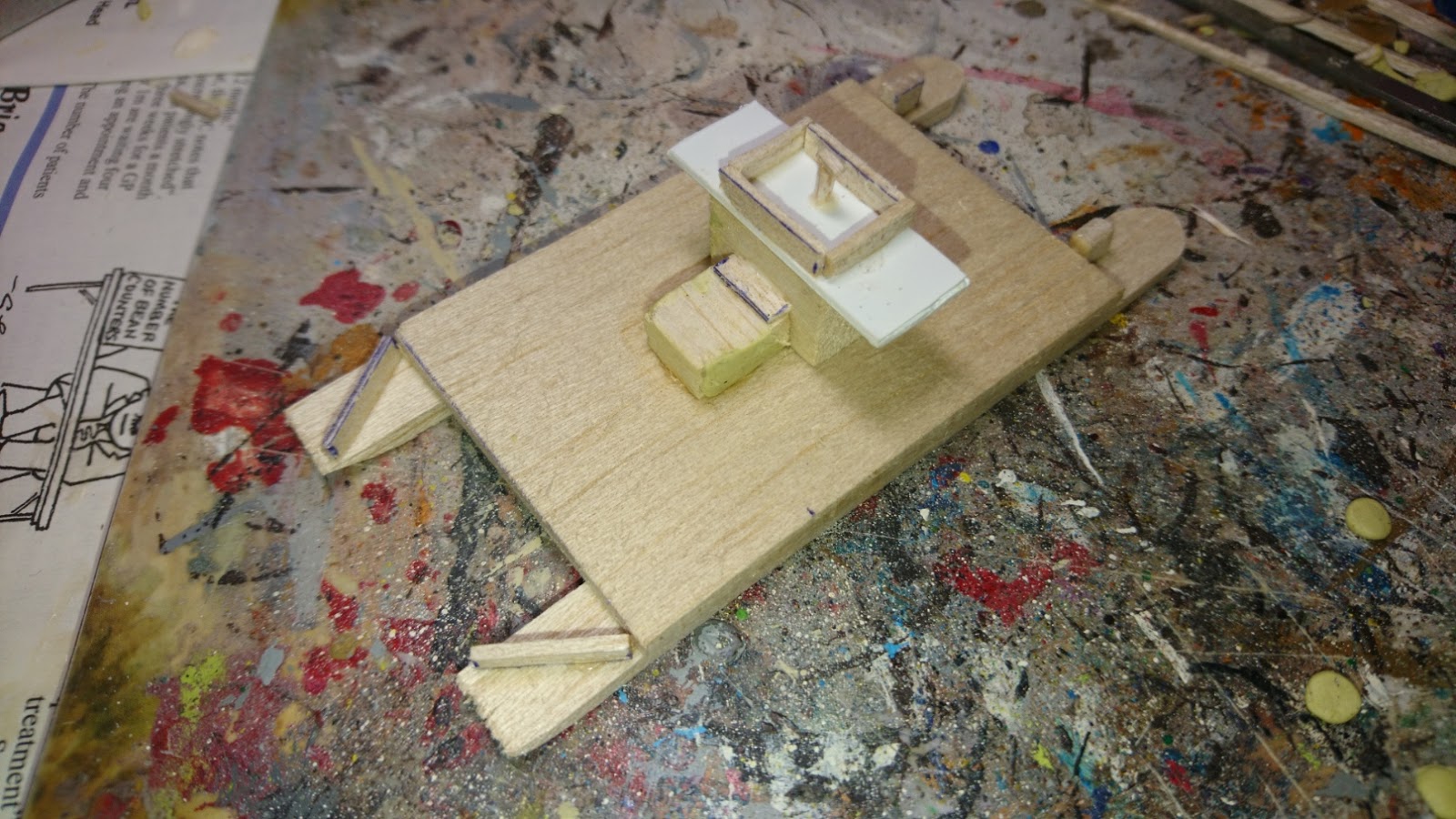
This is a really easy model to scratchbuild in 1:300 as it is all straight lines. I used three strips of balsa wood for the hull.

Completed Hull

A bit of sanding and a few simple additions in balsa and plasticard and I had a basic outline. Note that the conning tower could be placed in the middle for use as a flak battery or at the back to allow as much space as possible for vehicles. So feel free to move things around.

Seeing Double

I usually build two so if I screw up one, I still have the other.

Completed Flak Battery

And here is a completed model. I added four 88s, their trolleys, and two 40mm flak sourced from Heroics & Ross: using their German artillery men for the boat crew.

Second Siebel

Both models survived my primitive modelling skills. The second model has two 88s in the bows and two quod 20mm on towers at the rear, with a couple of prime movers.

The Deck

Flat balsa surfaces painted with normal acrylic can look like, well, painted wood - so I used a thick Tamiya textured 'concrete' paint to take out the wood appearance. It looks as if the horizontal surfaces of the ferry have been painted with anti-slip.

Scale Photo

This piccy shows the Siebels alongside a Warlord Games S-Boot and some scratch built I-Lighters.

These things were BIG and they packed a hell of a punch. They were also difficult to torpedo as they had a shallow draught.

Remains Of A Siebel

As far as I know, the only Siebels left are wrecks but, in their time, they gave good service for a quick bodge job.